
HOME   |   ABOUT   |   NEWS   |   TECH ARTICLES   |   AT THE TRACK   |   REVIEWS   |   VIDEOS   |   CONTACT ME

Cool Local Race Cars


Mk3 VW GTI: The first one is the 95 GTI IT-B car which, frankly, isn't too cool. It is a great car to drive (read more about my first race here) but besides that, there is nothing special about it. Until you find out about the work that went into it. I'm not just talking about the standard stuff, which in itself took a lot (a lot) of time and money to have the car as it is today, but I learned something even more impressive during the last race weekend.


The team apparently ran the cars on stock OEM hubs and never had a problem with them. Then, VW decided to switch the manufacturing for the hubs from Germany to China. The change in quality was dramatic. How dramatic? The wheels would fall off. The team tried to source the same hubs but to no avail. The solution? Build them. The team builds their own wheel hubs because they can't find the right parts. Brian Gay, who takes care of a lot of the maintenance and repairs on the race cars, machines the hubs for the cars. He also races (primarily) an E36 M3, which I mentioned in the last post about the last race weekend (The Ram's Eye is Racing (Again)!), and a Mk5 VW GTI. Speaking of which..


Mk5 VW GTI: I like this car because of the potential it has. It is owned by our team, Vantage Motorsports, who has been working on it to get all the issues sorted out and it's not quite there but it finally ran well the last race weekend. By well, I mean no boost leaks, no computer limp mode, etc. The suspension is still getting tuned and there are some fueling issues to keep up with the new found power..
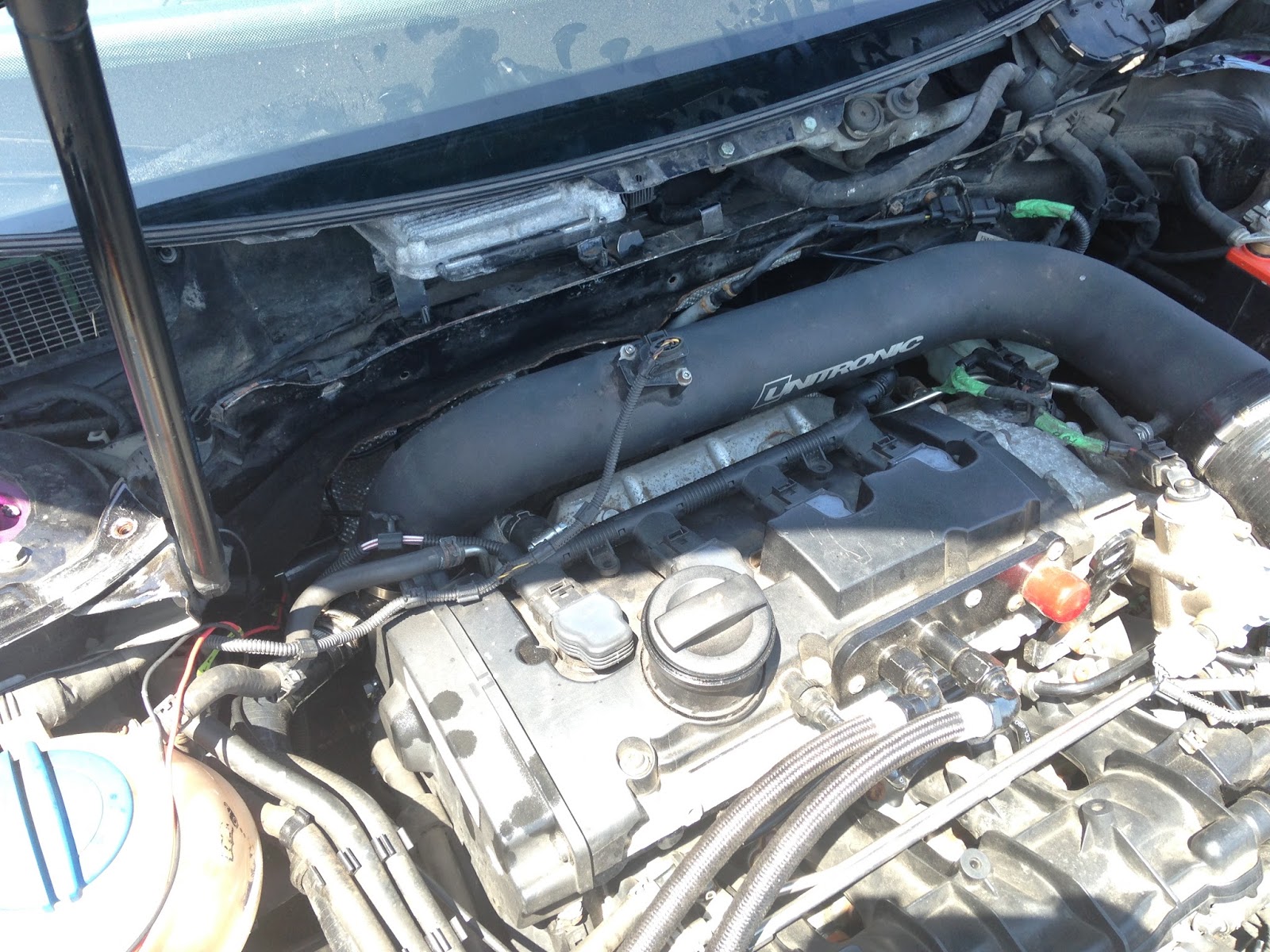


The team turbo swapped to a K04 turbo and is putting down around 330 hp and 330 lb-ft torque - a massive increase from the stock 197 hp. It weighs around 2,600-2,700 lbs I believe so power to weight ratio is really good too. The team also added a helical gear differential to help put the power down. The car is now running 1:18's but I suspect it'll be able to go much quicker once it's all sorted out.


E36 BMW M3: Finally, there is this E36 M3. At first, it looks unsuspecting. Then you notice the funny looking exhaust. Then you hear it and you realize it's very different.


The car is V8 swapped. It has a small block Chevy out of a Cadillac Escalade. They said it was out of a first generation Escalade but I'm not sure if they are referring to the actual and short lived first generation up to 2000 or the second and far more popular GMT800 Escalade. The car is putting down around 450 hp, far, far more than all other race cars, with the exception of a Monte Carlo Stock Car that was not running in the June race weekend. The car was a bit tricky, though, as I was told it was set up for drifting, including the diff, which makes it very tail happy. It's a lot of fun to watch but would be tough to drive fast, although it is already a quick car, running a best time on Saturday of 1:16.243. The team had some car trouble, unfortunately, and didn't run on Sunday but once the car is sorted out, including probably being tuned for road racing, the car should be even quicker. Some would consider an LS-swapped M3 sacrilege but I think it's cool. Which do you think sounds better, the first (blue) one or the second (white) one? Watch the video below and decide.


Comments


Does An Aftermarket Grille Really Increase Airflow?
I put a Saleen S281 grille to the test to answer that question.

Stock Suspension S197 Mustang With Square 305/30/19's
What you need to fit a proper size square tire setup.

How Limited Slip Diffs Make You Faster on Track
What you need to know about how they put power down and pros and cons.

Can Telemetry Explain Schumacher's Talent?
A comparison between Schumacher's and then team mate Herbert's data.


Cayman GT4 Track Review
The first Cayman with proper (911-challenging) power.

Is an EcoBoost Mustang any good on Track?
Two days at the track in a Mustang short 4 cylinders.

2016 BMW M4 DCT Track Review
It's quick (properly quick). But is it fun?

Can a stock Golf Diesel handle a Track Day?
Not your every day track beater.


🔥 Most Visited This Week

Limited Slip Differentials - The Basics

I'm finishing up a comparison post (link to introduction: Intro: Focus RS vs Golf R vs WRX STI vs Evo X ) and, throughout the post, I realized that I have to go off topic a lot to talk about how each type of differential changes the way the car drives. As a result, I thought I'd write a separate post to go into more detail before I post the comparison to keep it more focused on the cars and avoid veering off topic too much. By saying "Limited Slip Differentials" in the title, I am including torque vectoring diffs because, although current conventional terminology treats them differently, a torque vectoring differential is, in essence, a very sophisticated limited slip diff (LSD) that can be manipulated to actively help the car handle better. And while none of the cars in the comparison use open (without help from the brakes) or non-gear mechanical LSD’s, I’ll briefly discuss them so that the post is more inclusive. I’ll only focus on using power to help the...

Ford Focus RS vs Subaru WRX STI vs Mitsubishi Evo X MR

All these cars have one common Achilles' heel. The engines sit entirely ahead of the front axles; a great family recipe for understeer. Then tell the front tires - already taxed from trying to keep that front engine sitting outside the wheelbase from going straight - to put some power down and you can only make matters worse. There are ways to mitigate the understeer with suspension tuning, of course, but the toughest part is power-on understeer. I don't want to get much into tires, but the thing to remember is that because tires have a certain "grip budget" - how much total grip they can hold/generate before they let go - when you get on the power in a car that sends power to the front wheels (FWD or AWD), you will rob some of the precious grip you were relying on to turn the car in order to put all or some power down. You'll run out of front lateral grip sooner than you would have otherwise, as a result. Worse yet, because of the unideal en...

2015 Mustang GT breaks into the 11's in the 1/4 mile!

It went 11.77 seconds to be exact and past the traps at 116 mph and that's with minor modifications. The modifications were courtesy of the folks at Ford Racing. They recently got a hold of three 2015 Mustangs, one with the 2.3L EcoBoost engine making 310 hp and two GT's with the 5.0L V8 making 435 hp. The power modifications are minor for two of the three Mustangs. The 2.3 EcoBoost gets a "Prototype Off-Road Exhaust" which most likely means there are no catalytic converters or "cats", a more free flowing exhaust and a tune. One of the GT's gets the same off-road exhaust treatment and a tune plus "ARH Cobra Jet Long Tube Headers". In the video, they say they did "a few changes to the air intake system but basically these are close to what any consumer can buy" so they may have included a K&N drop-in filter which FRPP Performance Packs for the 2014 Mustang GT included or an aftermarket CAI with a cone style filter....

2016 Mustang EcoBoost Track Review

Photography by: Graham MacNeil Ford really wants to sell you a Mustang with a turbo four cylinder. They started by derating the V6 engine in the 2015 S550 compared to the 2011-2014 S197 V6 to make the EcoBoost 2.3 litre more differentiated. Then, they offered a performance pack on the EcoBoost but not on the V6. Now, they killed the V6 all together for 2018 and will only sell you a V8 or this EcoBoost. I love a good V8, everyone who knows me knows that. This is a Mustang, which means it needs a V8. If those aren't enough reasons, I always prefer natural aspiration over forced induction. That's three strikes against the EcoBoost-powered Mustang. But I'd be lying if I said the idea never intrigued me. It's the lightest (if you account for features). It has the best weight distribution. It has the same great chassis as the GT. It's very affordable and it has a lot of potential to make more power. Aftermarket? Endless support. There's plenty of good about it....